

Texas
Re-Imagined
SERIES
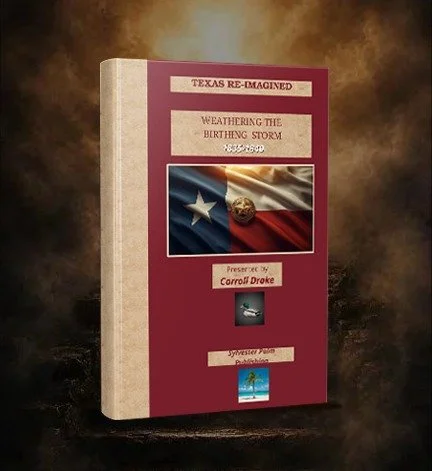
Why I
Write the Texas Re-Imagined Series
I was born in a small Texas town — Borger — and spent my first year in an even smaller Panhandle town called Stinnett. Our house had wood floors inside and a dirt floor in the garage. Stinnett had one stop sign at a T‑intersection, and the gas station hadn’t pumped a gallon in years. That was my beginning.
I grew up in Oklahoma in a family of seven – the other six were “Okies,” and they never missed a chance to rib me gently about being different — a Texan. And I wore that identity with pride. I grew up admiring the bravery of the Alamo, the heroism of its doomed last stand, and the names that were always held up as icons: Travis, Bowie, Crockett, Houston, Austin. Those names shaped my childhood understanding of Texas history.
But something was missing — and I didn’t know it until much later.
Everything came crashing down when I began researching my immigration policy book.
The Awakening That Changed Everything
I have always had a focusing issue when researching. One idea leads to another, and serendipity tends to drop unexpected connections right in front of me. That’s exactly what happened here.
I discovered that the American emigrants who went to Texas were not oppressed rebels fighting for freedom. They were, in fact, invited guests of Mexico — many of whom had been granted enormous tracts of land by the Mexican government. Those land grants made them wealthy, comfortable, and deeply invested in a lifestyle that depended on slavery.
Mexico banned slavery. The American settlers refused to give it up. And in the end, they bit the hand that fed them.
That realization hit me like a hammer.
The story I had grown up with — the one every Texan child hears — was incomplete. Not false, but incomplete in a way that mattered.
And then came the second shock.

The Alamo —
A Misunderstood Moment in Time
I learned that 20th‑ and 21st‑century Americans often judge Santa Anna’s actions through modern eyes. The order to “put the garrison to the sword” is seen as barbaric. But historically, for centuries leading up to the Alamo, it was accepted military practice that a garrison should surrender once it had shown its courage and it was clear they had no chance of success.
It was a brutal tradition, but it was a tradition.
If a garrison refused to surrender after that point, commanders often ordered exactly what Santa Anna did. It was not an exception. It was the norm.
That didn’t make the Alamo defenders any less brave. But it did make the story more complicated — and more human.
The Third Shock
A Question No One Ever Asked Me
I looked at the territory the United States “liberated” from Mexico:
Texas

Oklahoma Panhandle

Colorado

New Mexico

Arizona

Utah

Nevada

Upper California

And I asked myself a question that no one had ever asked me:
If Mexico still had all that territory today, in which direction would people seeking a better life [“illegal immigrants”] be heading?
That question changed everything.
It reframed the entire history of the region. It reframed the relationship between nations. It reframed the story I thought I knew.
And it led me to the three divergence points that form the backbone of the Texas Series.

The Three “What Ifs” That Could Have Changed the World
After months of research, reflection, and serendipitous discoveries, I identified three events — all historically plausible — that could have changed the course of world history dramatically if they had unfolded differently.
These three divergence points are the foundation of the Texas Series.
They are not wild fantasies. They are not impossible leaps. They are grounded in the actual conditions, motivations, and political realities of the time.
The Texas Series explores what the world might have looked like if those three events had occurred — and how Texas, Mexico, the United States, and the entire Western Hemisphere might have evolved under those alternate circumstances.
What This Series Is and What It Is Not
The Texas Re-Imagined Series is:

A broad, accessible alternate history exploration

Grounded in real historical conditions

Respectful of every culture involved

Written in clean, modern prose

Built around plausible divergence points

Designed to make readers think

Meant to entertain and illuminate
The Texas Re-Imagined Series is not:

A condemnation
of any group

A
defense
of any group

A
revisionist
manifesto

A
political
argument

A detailed
academic study

A
scholarly
treatise
It is a story — one built from curiosity, respect, and a desire to understand the past more honestly than I did as a child.
Why I Write It
I write the Texas Series because I want to explore the history I grew up with — not to tear it down, but to understand it more fully. I want to honor the bravery I admired as a child while acknowledging the complexity I discovered as an adult. I want to show how small changes in history can ripple outward and reshape nations, cultures, and lives.
Most of all, I write it because these questions came from my heart — from my own journey of learning, unlearning, and rediscovery.
This is the Texas Series. This is why I write it. And this is where the alternate history begins.